When buyers tell me they want to live somewhere they can walk out the front door and into the middle of things, Carytown is almost always the first place I take them. There is nowhere else in Richmond quite like it. Nine blocks of independent shops, restaurants, and one beloved 1928 movie palace, wrapped in some of the prettiest early-twentieth-century residential streets in the city — and all of it close enough to walk.
I have shown homes around Carytown to first-time buyers, downsizers, young professionals, and people relocating from much larger cities who could not believe a neighborhood this walkable existed at a Richmond price. This guide is the conversation I have with all of them: what Carytown actually is, what it is like to live here, what the real estate looks like in 2026, and who this neighborhood truly fits.
What and Where Is Carytown?
First, a clarification I make on almost every tour, because it matters for your home search. "Carytown" is the name of the commercial district that runs along West Cary Street, roughly from the Boulevard on the east end to Thompson Street on the west — about nine walkable blocks. Richmonders affectionately call it the "Mile of Style." It is a shopping and dining destination, not a subdivision.
When someone says they want to "live in Carytown," what they almost always mean is they want to live in the residential blocks that surround that commercial strip — the tree-lined streets just north and south of West Cary Street, where the houses and condos are. Those blocks sit at the meeting point of three of Richmond's most desirable areas: the Museum District just to the north, the Fan District to the east, and the leafy near-West-End streets to the south and west.
So when I help a buyer "find a home in Carytown," what we are really doing is finding a home within easy walking distance of the Cary Street corridor. That distinction shapes everything — the housing stock, the price, and the daily lifestyle.
The Carytown Lifestyle — Why Buyers Want to Be Here
The appeal is simple to describe and hard to replicate: Carytown lets you live a genuinely walkable life in a mid-sized Southern city.
From a home a few blocks off Cary Street, your coffee, your dinner, your Saturday-morning errands, a vintage-shopping afternoon, and a movie at night are all on foot. The retail is overwhelmingly independent — Carytown has kept the national chains largely at bay, and the result is a street that feels like itself. Boutiques, bookshops, a beloved toy store, restaurants spanning nearly every cuisine, coffee roasters, and specialty food shops sit shoulder to shoulder.
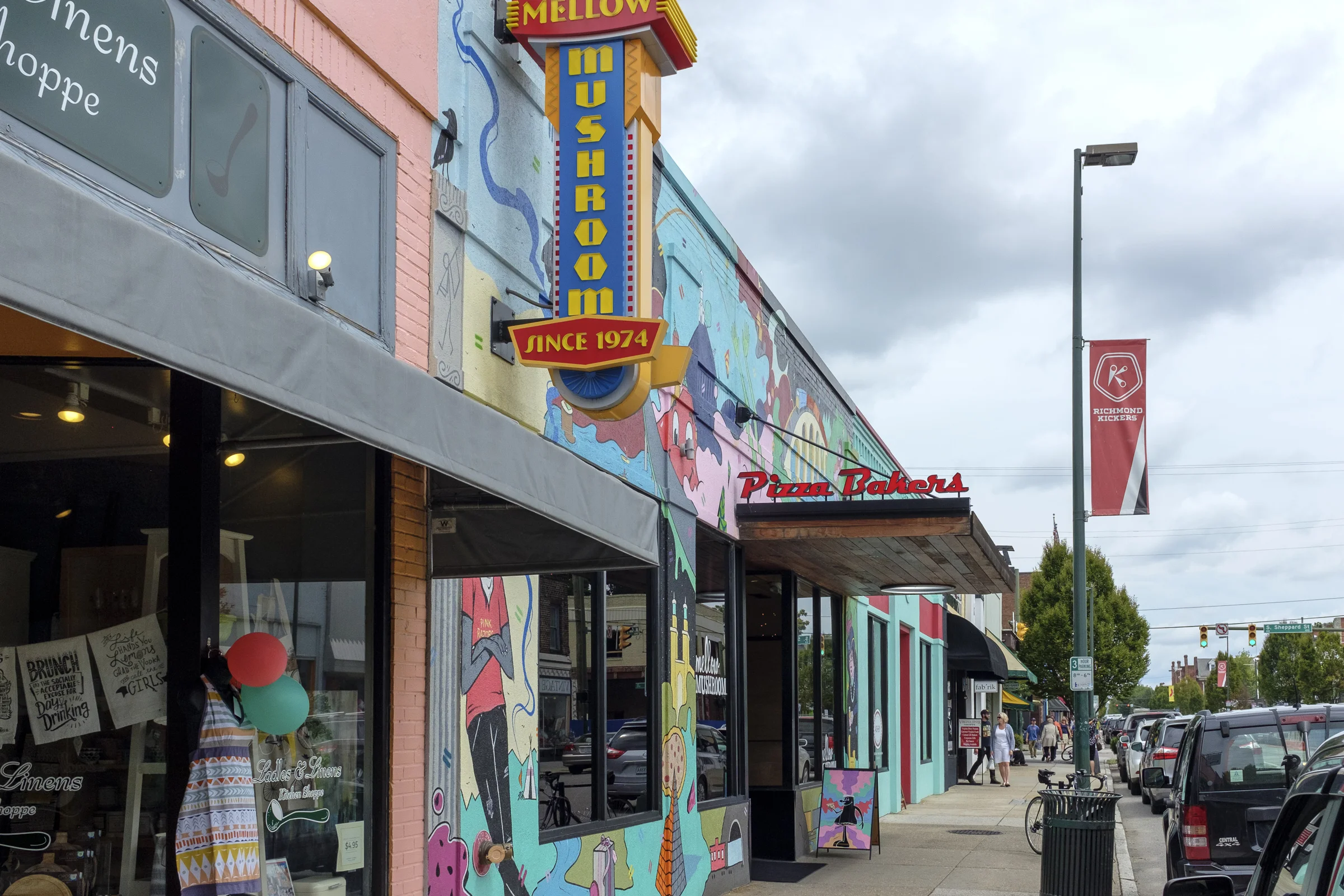
At the heart of it is the Byrd Theatre, the 1928 French Empire movie palace that still shows films nightly, still has its original Mighty Wurlitzer organ, and still anchors the district's identity. Every August, Carytown hosts the Watermelon Festival, regularly described as the largest one-day festival in Virginia, when the entire corridor closes to traffic and the city turns out.
For the people who live around it, Carytown is not an occasional outing — it is the backdrop of ordinary life. That is the thing my buyers fall for, and it is the thing that holds value.
The Real Estate Around Carytown
The housing stock in the blocks surrounding Carytown is a real mix, and understanding the categories is the key to a smart search.
Early-twentieth-century detached homes. The residential streets feeding into Carytown hold a wonderful inventory of homes built largely between roughly 1910 and 1940 — American Foursquares, Craftsman bungalows, Colonial Revivals, and Tudor-influenced cottages. Hardwood floors, original trim, front porches, and real architectural character are the norm. Lots are city-sized — modest yards, homes close to the street.
Rowhouses and attached homes. Closer to the Fan side, you find the brick rowhouse stock the Fan is famous for, in the transitional blocks between the two areas.
Condos and townhomes. There is a meaningful supply of condominiums and townhomes near Carytown, including converted historic buildings and purpose-built developments. For buyers who want the walkable Carytown life without the maintenance of an older detached house, this is often the entry point — and frequently the most attainable one.
Apartments and small multi-family. Some of the older homes have been divided into duplexes and small multi-family buildings, which occasionally creates an opportunity for an owner-occupant or a small-scale investor.
Carytown Home Prices in 2026
Pricing near Carytown reflects exactly what you would expect from a walkable, character-rich, supply-constrained city neighborhood: it carries a premium over much of the Richmond metro, and well-presented homes move quickly.
The bands below are drawn from Central Virginia Regional MLS activity and the comparables I track in this market. Treat them as a working framework — the right number for any specific home depends on the block, the condition, the square footage, and whether it has off-street parking, which is genuinely scarce here.
| Property Type | Typical 2026 Range | What It Buys |
|---|---|---|
| Condos & townhomes | $275,000 – $500,000+ | One- to three-bedroom units; the most attainable path into the area |
| Smaller detached homes & bungalows | $400,000 – $625,000 | Two- to three-bedroom early-1900s homes, often partially updated |
| Larger / fully renovated homes | $625,000 – $950,000+ | Four-bedroom Foursquares and Colonials, renovated, on the best blocks |
A few honest notes on the market. Inventory near Carytown is tight — these are established blocks with no room for new subdivisions, so supply depends almost entirely on turnover. Well-priced, updated homes in good condition often go under contract quickly, sometimes with competing offers. Homes that need work trade at a discount and are absorbed fast by buyers who want into the area and are willing to renovate. If Carytown is your target, the right preparation is to be fully pre-approved and ready to move when the right listing appears.
Walkability and Location
This is Carytown's defining advantage, and it is real. The blocks around the corridor post some of the highest walkability in the entire Richmond region — for many homes here, a car becomes a convenience rather than a necessity for daily life.
Beyond the corridor itself, the location is central in every direction. Downtown Richmond is a short drive or bike ride east. The Museum District — home to the Virginia Museum of Fine Arts, which is free to enter — is immediately north. The Fan, Richmond's grandest historic residential district, is right next door. Interstate access via the Downtown Expressway is quick, putting the broader metro and Richmond International Airport within easy reach. The James River and its park system are a short trip south.
For a buyer weighing a walkable city life against a longer-commute suburban one, Carytown is the clearest place in Richmond to see what the walkable version actually feels like.
Schools
Homes around Carytown fall within the City of Richmond and are served by Richmond Public Schools. Assigned elementary, middle, and high schools depend on the specific address, and city school attendance zones are adjusted from time to time.
Because school zoning is one of the most consequential — and most frequently misunderstood — parts of a Richmond city home search, I always verify the current assigned schools for any specific property a family is serious about, rather than relying on a general assumption. Richmond Public Schools also operates specialty and magnet programs that many city families pursue, and I am happy to walk families through how those options work alongside the assigned-school path.
Who Carytown Fits
After many years of matching buyers to Richmond neighborhoods, here is the buyer I see thrive around Carytown:
The buyer who genuinely wants to walk. If a walkable daily life is at the top of your list — not a nice-to-have but the actual priority — Carytown delivers it better than almost anywhere else in the metro.
Young professionals and first-time buyers. The condo and townhome inventory makes the area reachable for buyers earlier in their path, and the lifestyle is a strong fit for people who want to be in the middle of the city's energy.
Downsizers coming in from the suburbs. I work with a steady stream of buyers trading a big suburban house and yard for a lock-and-leave home or condo where everything is on foot. Carytown is one of the most popular landing spots for that move.
Character-driven buyers. People who want an old house with real architecture, original detail, and a story — and who are not looking for new construction — find a lot to love in the early-1900s stock here.
It is a less natural fit for a buyer whose top priority is a large lot, abundant off-street parking, brand-new construction, or a quiet cul-de-sac. Those buyers are usually happier in Richmond's suburbs, and that is a perfectly good answer — it is simply a different one.
What to Know Before You Buy Near Carytown
A few practical points I make sure every Carytown buyer hears:
Parking is a real consideration. Off-street parking is limited in these blocks. A home with a driveway, a parking pad, or a garage carries a genuine premium, and it is worth deciding early how much that matters to you.
These are older homes. Most of the detached housing stock is 85 to 115 years old. A thorough inspection by someone experienced with historic Richmond homes is essential — roofs, original windows, electrical and plumbing systems, and foundations all deserve close attention, and the budget should reflect a home of that age.
Condo buyers must read the documents. If you are buying a condo or townhome, the association's budget, reserves, rules, and fees matter as much as the unit itself. I always make sure my buyers review those documents carefully before the contingency period ends.
Move quickly when the right home appears. Because inventory is tight and demand is steady, the gap between "thinking about it" and "it is under contract" can be days. Being fully pre-approved and decisive is part of winning here.
Frequently Asked Questions
Is Carytown a good place to live in Richmond?
For buyers who want a walkable, independent-minded, character-rich city neighborhood, it is one of the best in Richmond. You trade larger lots and easy parking for the ability to live much of your daily life on foot, surrounded by independent shops, restaurants, and the historic Byrd Theatre.
How much does a home near Carytown cost in 2026?
Condos and townhomes generally run from the high $200,000s to just above $500,000. Smaller detached homes and bungalows typically fall between roughly $400,000 and $625,000, and larger renovated homes on the best blocks can reach $950,000 and above. The right number always depends on the block, condition, and parking.
Can you actually live in Carytown, or is it just shops?
Both. The Cary Street corridor itself is commercial, but the surrounding residential blocks — at the crossroads of the Museum District, the Fan, and the near-West End — are where people live, within easy walking distance of everything.
What schools serve homes near Carytown?
Homes near Carytown are in the City of Richmond and served by Richmond Public Schools, with the assigned schools depending on the exact address. Because zones change, I verify current school assignments for any specific home a family is considering.
Is Carytown walkable?
Yes — it is one of the most walkable areas in the entire Richmond region. For many homes in the surrounding blocks, daily errands, dining, and entertainment are all reachable on foot.
Thinking About a Home Near Carytown? Let's Talk.
Carytown is a neighborhood that rewards knowing the blocks — which streets have parking, which homes have been quietly renovated, what is about to come to market before it is listed. That is exactly the kind of local knowledge I bring to a Carytown search.
If you are considering a move to Carytown or anywhere in Richmond's walkable city neighborhoods, I would love to help. We can start with a walking tour of the area so you can feel the streets for yourself, then work the active listings and my off-market network together to find the right home.
Call or text me directly at (804) 391-9294, email michela@ownrva.com, or use the contact form on this page — and let's start the conversation.
Michela Worthington is a licensed REALTOR with The OwnRVA Group, brokered by Real Broker, LLC. She holds the ABR (Accredited Buyer's Representative) and SRS (Seller Representative Specialist) designations, is a member of REALM Global, and represents luxury clients through Real Luxury, the luxury division of Real. She lives and works in the Richmond metro and specializes in the city's most distinctive neighborhoods.